Next.js vs Laravel in 2026: Choosing the Right Stack for Your Business Website
Next.js and Laravel solve different problems. Here's how to tell which one your business website or product actually needs in 2026 — and when it's worth using both.


Webnyxa Technologies
34 views
Choosing a web framework in 2026 is less about which technology is "best" and more about which one fits your team, your timeline, and what your website actually needs to do. Two names dominate almost every client conversation we have at Webnyxa: Next.js, the React-based framework built for fast, interactive frontends, and Laravel, the PHP framework built for structured, data-heavy backends. Both are mature, well-supported, and capable of powering serious business applications. They just solve different problems.
Two Frameworks, Two Philosophies
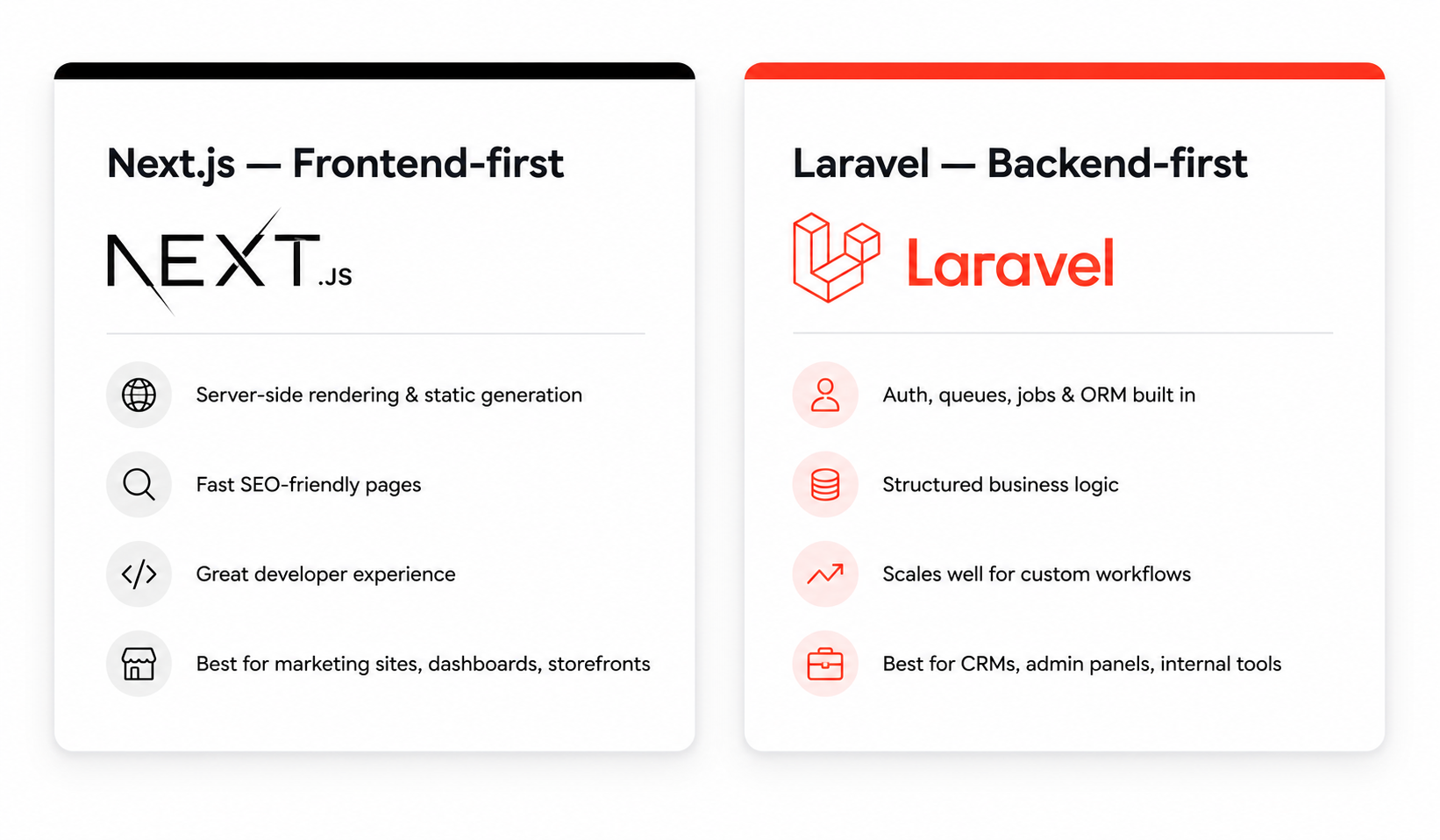
Next.js is frontend-first. It renders React components on the server or at build time, ships fast, SEO-friendly pages, and gives developers fine-grained control over rendering strategy — static generation, server-side rendering, or client-side interactivity, often on the same site. It shines when the experience itself is the product: marketing sites, SaaS dashboards, storefronts, content platforms.
Laravel is backend-first. It gives you authentication, database migrations, queues, scheduled jobs, and the Eloquent ORM out of the box, all wired together with sensible defaults. It shines when the logic behind the scenes is the product: booking systems, CRMs, internal tools, multi-step workflows, anything with real business rules.
Neither framework is trying to be the other. That's the point.
Where Next.js Wins
Reach for Next.js when your priorities are page speed, SEO, and a highly interactive interface. It's the stronger choice for content-heavy marketing sites and blogs that need to rank well, e-commerce storefronts where load time affects conversion, customer-facing dashboards with lots of live data, and products that deploy naturally to edge networks like Vercel for global performance.
Where Laravel Wins
Reach for Laravel when your priorities are structured data and business logic. It's the stronger choice for CRMs, admin panels, and internal tools, applications with complex permissions, workflows, or approval chains, systems that need mature, battle-tested patterns for auth, billing, and background jobs, and teams already comfortable with PHP and MySQL hosting environments.
You Don't Always Have to Choose
A growing pattern in 2026 builds pairs both frameworks together: Laravel as an API backend handling data, auth, and business logic, with Next.js as the frontend consuming that API and handling the user experience. This split gives you Laravel's backend maturity and Next.js's frontend performance in a single application, at the cost of a slightly more complex deployment setup. For businesses planning to scale past a simple website into a full product, this hybrid approach is often worth the extra coordination.
Cost, Timeline, and Team Fit
Framework choice affects more than code. Next.js projects are often faster to launch when the scope is primarily a website or a frontend-heavy product, and hosting on platforms like Vercel is simple to manage. Laravel projects tend to take a bit longer up front because more of the business logic lives in the backend, but that investment pays off as the application grows in complexity. Hiring also matters: Next.js/React talent and Laravel/PHP talent are both widely available, but they're different talent pools, and long-term maintenance is easier when the stack matches the skills already on your team.
Our Recommendation
If your site is primarily about content, speed, and user experience, start with Next.js. If your product is primarily about data, workflows, and business rules, start with Laravel. If you're building something that needs both a polished frontend and serious backend logic, plan for a Laravel API paired with a Next.js frontend from day one rather than retrofitting it later.
There's no universally "right" stack, only the right stack for what you're building. At Webnyxa, we build in both, which means the recommendation you get is based on your project, not on which framework we'd rather use. If you're weighing this decision for an upcoming build, we're happy to talk through the tradeoffs for your specific case.
Comments
No comments yet. Be the first to share a thought.