Transforming Our Blog into a Publishing Powerhouse
Discover how we evolved our blog from a simple platform to a robust publishing system designed for collaboration and engagement.



8 views
We Stopped Treating Our Blog Like a Brochure
How rebuilding our publishing workflow helped us create better content, collaborate more effectively, and understand what readers actually care about.
Introduction
For a long time, our blog looked good—but it didn't work like a modern publishing platform.
The process was simple. Someone wrote an article, clicked Publish, and hoped people would discover it. There wasn't much support for collaboration, very little insight into how readers interacted with our content, and almost no tooling to help the people creating it.
That approach was fine when we published once in a while.
But as our blog became the place where we shared product updates, engineering insights, case studies, and company knowledge, it became clear that the workflow wasn't built for the way we actually worked.
We didn't need another redesign of the blog itself.
We needed to rethink the entire publishing experience.
The Moment We Knew It Had to Change
A modern content team needs much more than a text editor.
Publishing consistently requires tools that reduce friction, encourage collaboration, and provide meaningful feedback after an article goes live.
Our goals were simple:
Help writers publish faster.
Give every team member clear ownership of their work.
Understand how readers engage with content.
Deliver a better reading experience for visitors.
Instead of treating the blog as just another page on our website, we started treating it like a product—with its own users, workflows, and continuous improvements.
Building Around Real Publishing Work
We weren't trying to build another enterprise CMS packed with features nobody would use.
Instead, every improvement had to answer one question:
Does this make publishing easier or help us make better decisions?
If the answer was no, it didn't make the roadmap.
That philosophy led us to a much cleaner publishing workflow:
Write → Review → Publish → Measure → Improve
It's a simple loop, but today it drives every improvement we make.
Making Writing Feel Effortless
One of the biggest bottlenecks wasn't writing the article itself.
It was formatting it.
Writers spent unnecessary time adjusting layouts, organizing sections, and making content look presentable.
So we rebuilt the editor to make writing feel natural.
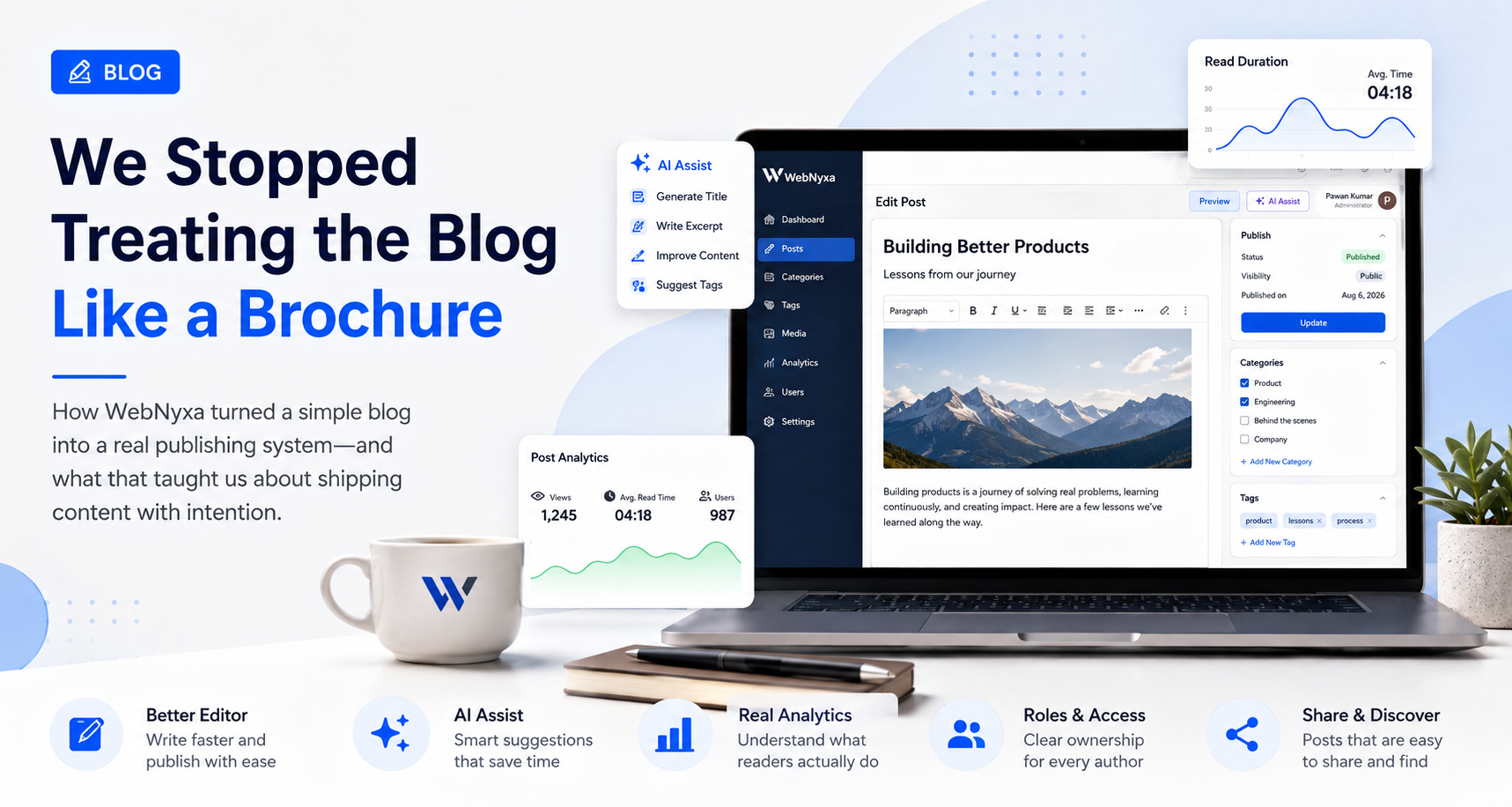
With richer formatting, embedded images, and better content organization, the editor now stays out of the writer's way. Instead of fighting the interface, authors can focus on telling better stories.
Good writing tools should disappear into the background—and that's exactly what we wanted.
AI That Helps Without Taking Over
One thing we noticed was that writers rarely struggled with the main article.
The difficult part was often everything around it—titles, summaries, introductions, and metadata.
Rather than asking AI to generate entire blog posts, we used it where it genuinely saves time.
It now assists with things like:
Blog titles
Excerpts
Meta descriptions
Content sections
Improving existing copy
The philosophy is simple:
AI suggests. Humans decide.
It removes the friction of getting started while keeping creativity, expertise, and editorial judgment exactly where they belong—with the writer.
Looking Beyond Page Views
Most analytics tools answer a very basic question:
How many people visited the page?
That's useful—but it doesn't tell the whole story.
We wanted to know whether people actually read the content.
Our publishing platform now provides insights into reader activity, reading duration, engagement trends, and visitor behavior for every post.
Instead of celebrating page views alone, we can ask much more meaningful questions:
Did readers stay until the end?
Which articles keep attention the longest?
What type of content performs best?
What should we improve next?
Those insights now influence both our editorial strategy and future product decisions.
Making Collaboration Simple
Shared admin accounts work when one person manages a blog.
They become a problem as soon as a team starts growing.
To solve that, we introduced role-based access and individual ownership.
Every team member now has their own account, secure authentication, password recovery, and permissions that let them manage only the content they own.
It's one of those features that people barely notice when everything works—but immediately appreciate when they don't have to worry about accidentally changing someone else's work.
Improving the Reading Experience
Better publishing tools only matter if readers benefit from them too.
Alongside the internal improvements, we also refined the public blog experience.
Readers can now discover related articles more easily, share content across platforms, navigate between posts more naturally, and enjoy cleaner content presentation.
Publishing isn't just about getting articles online.
It's about making them easier to discover, read, and share.
What We Learned Along the Way
Building internal tools taught us several valuable lessons.
Ship Useful Features, Not Endless Features
There's always another feature that could make the editor more powerful.
But we kept asking ourselves one question:
Will this help someone publish this week?
If not, it could wait.
Measure What Matters
Collecting data is easy.
Finding data that actually changes decisions is much harder.
Instead of building dashboards full of vanity metrics, we focused on insights our team genuinely uses.
AI Works Best as an Assistant
Generating complete articles often produces generic content.
Helping writers with specific tasks proved far more valuable because it supports creativity instead of replacing it.
Permissions Are More Than Buttons
Role management isn't just about hiding menu items.
It includes authentication, ownership, account recovery, editing rights, and secure workflows.
Most of that work stays invisible—but it's essential to making collaboration feel effortless.
Better Tools Don't Write Better Stories
Around the same time, we rewrote several case studies and product stories.
That reinforced one important lesson.
A better CMS doesn't create better content.
It simply makes great content easier to create, publish, and improve.
Where We Are Today
Today, our blog feels much closer to a dedicated publishing platform than a traditional CMS.
Writers create content faster.
Teams collaborate with confidence.
Analytics guide editorial decisions.
Readers enjoy a cleaner, more engaging experience.
Most importantly, publishing has become part of our weekly rhythm instead of an occasional task.
Key Takeaways
Treat Your Blog Like a Product
Your publishing platform deserves the same attention as any customer-facing feature.
Editor experience, permissions, analytics, and reader experience all contribute to better content.
Consistency Beats Complexity
The best feature isn't always the most impressive.
It's the one that removes another obstacle between an idea and a published article.
Focus on Meaningful Engagement
Traffic tells you who arrived.
Reader attention tells you who stayed.
That's the metric that leads to better editorial decisions.
Let AI Accelerate Creativity
AI is most valuable when it helps people move faster—not when it replaces their expertise.
Use it to eliminate repetitive work while keeping human judgment at the center.
Build for Teams, Not Individuals
As content grows, ownership becomes increasingly important.
Clear permissions create confidence, reduce bottlenecks, and make collaboration far easier.
Looking Ahead
The platform now gives us a solid foundation, but we're far from finished.
Our focus isn't on adding features for the sake of it.
It's on creating a publishing system that helps our team produce valuable content consistently.
We'll continue improving the writing experience, learning from reader behavior, and evolving the platform based on how people actually use it.
The biggest lesson from this journey wasn't technical.
It was philosophical.
Instead of asking,
"Which CMS should we use?"
we now ask,
"What would make it easier for our team to publish something valuable this week—and know whether it actually helped someone?"
That question continues to shape every improvement we make.
Comments
No comments yet. Be the first to share a thought.